

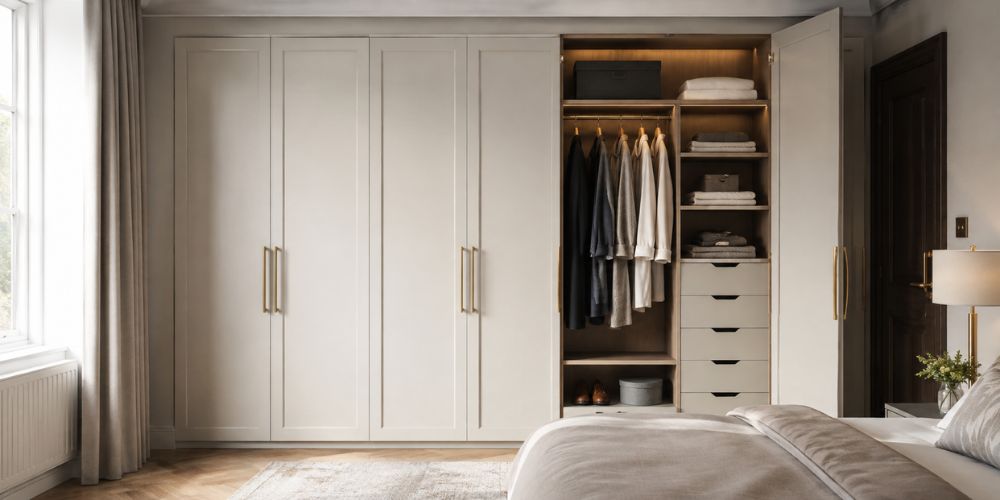
A fitted wardrobe can look like a fairly simple purchase until the measuring starts. One wall is straight. Another bows slightly. A radiator sits close to the corner. The ceiling drops near an old chimney breast. Small details like these change the job before paint colours or handles enter the conversation.
For many homeowners, how much do built in wardrobes cost becomes the first practical question once storage starts feeling tight. Horizon Bespoke Joinery works with rooms as they are rather than treating every bedroom like a standard box. That makes the room itself part of the price discussion from the beginning.
What Does a Fitted Wardrobe Usually Cost?
Across Ireland, straightforward fitted wardrobes are currently advertised from around €1,200. Broader 2026 cost guidance places standard installations roughly between €1,200 and €3,000, with more involved bespoke work moving higher as materials, size and extras increase.
A short run with shelves and hanging space is one type of job. Full height cabinetry across a wall is another. Add drawers, mirrors, lighting or a difficult ceiling and the workshop time changes again.
A starting price is useful for budgeting. It is not much help without knowing what has actually been included.
The Room Can Quietly Add Cost
A clean rectangular wall gives a joiner fewer surprises. Older houses are not always that cooperative. Floors can fall slightly. Corners may not sit at a true right angle. Skirting can project further than expected.
Those details are usually dealt with during fitting so the wardrobe appears straight even when the room is not. That takes time and can require filler panels, scribing or extra cutting on site.
Position deserves thought before a design is approved. Horizon’s guide to wardrobe position in a bedroom explains why bed clearance, windows and walking space need checking. A wardrobe can fit perfectly on a drawing and still leave a drawer hitting the bedside table every morning.
Materials Change the Quote Quickly
Painted MDF remains a common choice because it gives a smooth finish without pushing the budget towards solid timber. Veneers, sprayed lacquer, mirrored panels and timber details tend to cost more.
Door construction changes the workload too. Plain slab doors are fairly direct to make. Shaker fronts involve additional machining. Sliding doors need tracks and suitable hardware. Mirrored sections bring another material into the build.
When a wardrobe forms part of bespoke bedroom furniture, matching nearby pieces can influence the specification. A bedside unit next to the wardrobe can expose a small difference in paint tone or handle height. Those details seem minor on paper. They are easy to notice once the room is finished.
The Inside Often Decides the Real Cost
Most early attention goes to the doors. The inside often has a bigger effect on everyday use.
A basic interior may need one rail and several shelves. Someone storing work shirts may get more from double hanging. Long dresses need proper drop space. Shoes take up more room than expected. Suitcases often end up on the highest shelf.
Drawers increase cost because they need boxes, fronts and runners. Pull out accessories, shoe racks and internal lighting add more parts again. None needs to be included simply because it appears in a showroom display.
Storage works better when it reflects what is already owned. Six narrow shelves may look organised in a drawing but become annoying if most clothes hang. A large top shelf can be useful for bedding, provided it can actually be reached.
Bespoke Does Not Suit Every Bedroom
Freestanding furniture still has a place. It makes sense in rentals, temporary bedrooms and rooms likely to change purpose. It can be moved and replacement is usually easier.
Built in storage becomes more convincing when standard furniture keeps wasting space. A high ceiling can provide storage above normal wardrobe height. An alcove can be filled instead of becoming an odd gap.
Horizon’s comparison of built in and freestanding wardrobes is useful when that choice is not obvious. Cost is part of the decision. How long the furniture will stay in the room matters too. Spending heavily on fitted storage before a planned renovation may not make sense.
What Should a Wardrobe Quote Include?
A lower quote is not automatically a bargain. The useful question is what sits inside that number.
Materials, door style, handles, shelves, rails and drawers should be clear. Delivery and installation should also be stated. If lighting is planned, electrical work needs to be accounted for. Removal of an old wardrobe is another item that can easily be missed.
Two quotations can be hundreds or thousands apart and still describe different jobs. One may include fitting and painted finishes. Another may stop at manufacture. Reading the specification line by line matters.
An early estimate from photographs can help with budgeting. Final pricing usually needs proper measurements because a photo will not reveal every uneven wall, socket or skirting detail.
Late changes can be costly. Adding drawers after production begins may require different panels, runners and internal dimensions. Settling those choices before manufacturing keeps the quote easier to follow.
Conclusion
Built in wardrobe pricing becomes easier to understand once the room and specification are clear. Size matters, but an awkward corner, extra drawer or chosen finish can influence the figure just as much.
Horizon’s Built In Wardrobes service gives homeowners a clearer route from room measurement to made to measure storage. A detailed quote should show what is being built, what is included and which choices are shaping the final cost.