

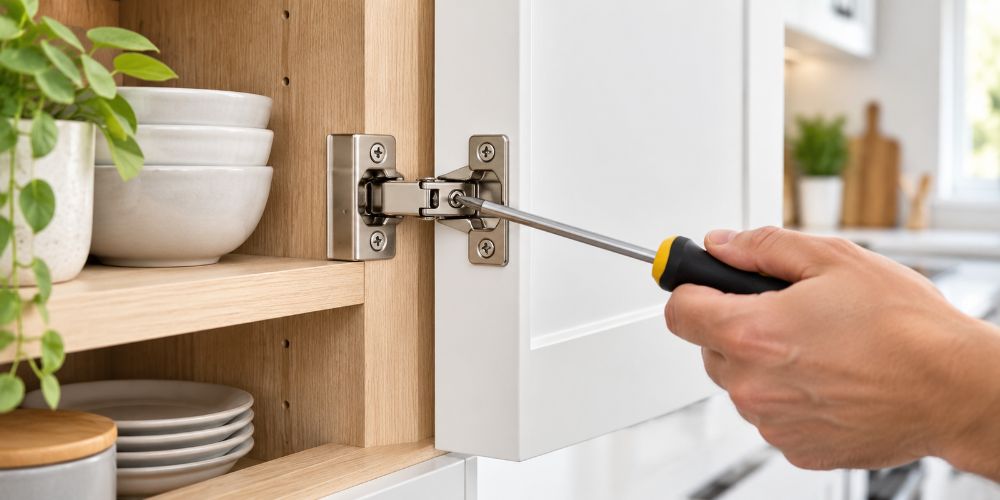
One kitchen door is lower than its neighbor. Another catches the drawer below. You have to push the cabinet next to the fridge to shut it. These difficulties don’t always imply the cabinets are deteriorating. Often a hinge is just not true.
Most contemporary cabinets employ adjustable, hidden hinges. Horizon Bespoke Joinery has shown us the joinery work with perfectly installed cabinets. Small gaps are particularly evident when doors are lined up in a straight row. Usually a screwdriver and a little patience is all it takes.
Identify the Kind of Hinge You Have
Opening the door shows the hinge. A common hidden hinge features a spherical cup that is recessed into the door, an arm and a mounting plate that is secured within the cabinet. Normally, it permits adjustability in three directions. Older butt hinges may not have these controls.
It is manufacturer dependent. On many European hinges, screws on the arm control sideways movement and depth. The height is changed at the mounting plate, occasionally with a separate cam screw.
This is a significant difference. Treat a fixed screw like an adjustment screw and you may loosen the door and not straighten it.
Look For The Gaps Before Touching the Screws
The issue is simpler to see with the doors closed. A modest gap at the top that grows toward the bottom often shows the need to adjust the sideways alignment. A door lying under the one adjoining may have to be raised.
One corner of the door sticks out and it requires a different adjustment. That’s often a depth problem but a warped door might seem similar.
Some tests stop unnecessary effort:
- Uneven vertical spaces: Check alignment left to right.
- Door too high or too low: Check height of mounting plate.
- Door proudly sitting: • Check depth and closing clearance.
- Whole hinge moving: First check the anchoring screws.
If the initial adjustment makes problems worse, a pencil notation next to the original screw location might assist. A manual screwdriver offers more control in this instance than a drill. Some hinge screws require a Phillips bit, some a Pozidriv bit. The incorrect tip might slide and grind away the screw head before the door moves an inch.
Adjust Door Left or Right
Sideways is frequently the easiest to change. Many hidden hinges include a screw on the front of the hinge arm which adjusts how much the door overhang the cabinet edge.
There are just minor turns. Turning a quarter and shutting the door reveals whether the gap is narrowing. Turning direction depends on the hinge design, thus it is better to observe the movement rather than to remember guidelines for clockwise direction. It helps to have the other door closed for comparison.
If the top corner is too near to the next door, try moving the top hinge. Then a slight adjustment may be necessary at the bottom hinge to maintain the edge straight.
It is worth supporting heavy doors in this task. It also makes sense to first empty the shelf adjacent, since a cluttered pantry cupboard might make the hinges tough to get to.
If You Have Any Sagging Door
After opening and shutting for years, a cabinet door might become unaligned. Height adjustment aligns its top edge with adjoining doors.
Some of the hinge plates contain a cam that is rotated to raise or lower the door. Some of the others have extended mounting holes. These the attaching screws are a little slackened when the door is supported and the plate shifted up or down.
Adjust a Sticking or Rubbing Door
The depth adjustment makes the door closer to the cabinet body or away from it. A corner that sticks out or a door that drags when you close it will do.
The depth control is normally located further back on the hinge arm. Before the hinge arm will move there may be a cam or screw that has to be removed. It is contingent upon the model.
Work on one hinge at a time to get a sense for what the movement is going to be like. After each minor modification, carefully shut the door to verify clearances. Pushing the door too far in might damage the cabinet edge or prevent the gentle close from operating correctly. If a soft-close door slams shut even when it’s precisely aligned, the damper can be defective or worn out. It may not be as easy as just adjusting the hinge.
When Adjustment Just isn’t Enough
If the hinge continues slipping out, the screw holes may be stripped. If you hear screws spinning, cracks around the hinge cup or a bent metal arm, then it needs to be fixed, not adjusted.
Water damage may also cause a cabinet panel to bulge and misalign. If you observe a lot of uneven doors, the issue may really be the cabinet fix or level.
Turning the adjustment screw beyond its limit might harm the hinge. Replacement hardware must match the original fastening pattern, opening angle and thickness of the door.
Conclusion
You may learn how to adjust hinges. Slight problems with cabinet doors might be a nuisance.
The aim is to find out whether the gap needs a horizontal, vertical or depth correction. Adjust a little bit and see what happens. Custom kitchen renovation could need more than a basic hinge tweak if the cabinet is fractured or the doors don’t fit the openings anymore.