

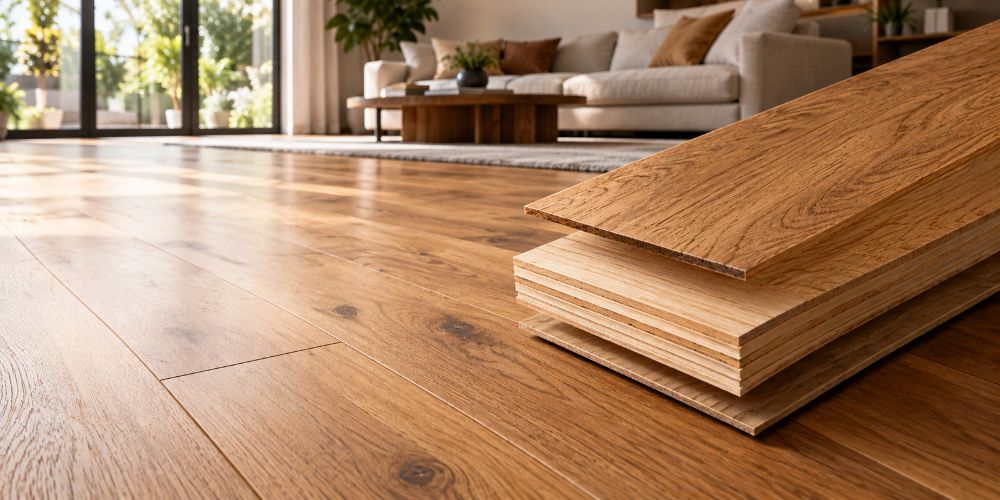
A hardwood floor may be warm enough underfoot without radiators invading wall space, but that doesn’t imply every timber plank can sit atop a heated subfloor. Wood is sensitive to temperature and humidity. Too much heat might dry it out and make gaps between boards or a floor seem less steady than you anticipate.
At Horizon Bespoke Joinery we deal with wood flooring and fitted interiors where the floor build up has to suit the space as well as the finish, for houses contemplating the combination. That balance is more important than the heating label.
Can you use Underfloor Heating with Wood?
Yes, it does in a lot of cases. The big question is whether the floor you pick is suitable for the heating system underneath.
The issue is can you have underfloor heating with hardwood flooring, the answer is typically a straightforward yes, but there are nuances. Wood insulates better than stone or tile.
This means the system has to work harder because of the thick boards. The floor also swells and shrinks with moisture changes.
Most manufacturers restrict the maximum floor surface temperature. For wood flooring a number in the region of 27C is normal. The actual limit should be given by the flooring manufacturer, not an estimate based on thermostat setting.
Why Engineered Wood Is Usually Better For It
Engineered wood is made up of numerous layers, not one solid piece of lumber. The top layer is composed of genuine wood. Beneath it, cross laminated portions make the board resistant to movement.
That structure makes engineered flooring a popular alternative to underfloor heating. It still talks to the room, but not as strongly as plenty of solid boards.
Board thickness counts. An extremely thick floor may restrict the heat getting into the room. Usually a thinner board will be more suitable and will pass heat more easily but will still look like wood.
Price may vary according to species, kind of wear layer and installation. Why do two floors that appear the same cost so differently? Horizon’s guide to how much engineered wood flooring costs explains.
Solid lumber is not automatically excluded. Some items are authorized for heated flooring. Others aren’t. Manufacturer guidelines should answer that question before ordering a board.
Count of Temperature and Moisture
The heating is there so wood doesn’t fail often. Problems frequently arise when the temperature or moisture changes too fast.
A floor that is cold and then hot again may dry unevenly. There may be gaps. Boards may also shift when they were put in while the structure was still moist.
The heating system should deliver a uniform temperature across the floor. Hot patches are not beneficial, since one region of lumber may dry quicker than another. A floor sensor is typically used to maintain the surface within the flooring manufacturer’s limit.
Also one should consider the humidity of the room. If the air is really dry then wood might shrink. It might swell up in high humidity. New screeds, plastering and other wet tasks should be dried prior to laying the final floor.
What Is Changed During Installation?
If the heating is under the boards, installation requires extra preparation.
The subfloor has to be level, dry and acceptable for the fastening technique you have selected. It is particularly crucial to check moisture levels in concrete before applying glue, underlay or lumber. The guide to laying engineered wood flooring on concrete explains the basic preparation that will impact on the finished floor.
The heating system should previously have been checked before flooring installation. Some manufacturers’ instructions may require it to be shut off for a time around installation.
Usually after the floor is laid the heat should come back up gradually rather than cranked up. Some flooring manufacturers need temperature rises in steps. If you glue down the floor, adhesives also require time to cure.
Expansion gaps still count. Timber continues to move slightly during the year, heated.
Common Mistakes Issue
Even an excellent floor may perform poorly when the surrounding features are inappropriate.
Common errors include:
- Selecting timber without considering compatibility with heating
- Very thick carpets on the floor
- Shaking down the system after installation
- Ignoring moisture in a fresh concrete screed.
- Using a poor underlay that inhibits heat
- Allowing the floor surface to exceed the permitted limit
Big carpets and furnishings may hold heat in one location. This may generate a warmer area under the cover with the rest of the room seeming chilly.
A thermostat also requires the correct controls. Air temperature alone is not necessarily enough to describe what is occurring at the surface of a wood floor.
Choosing the Right Floor for Your Room
It’s not all about appearance for the right mix.
A busy kitchen may need a hard-wearing engineered finish with a strong core. By contrast, a bedroom normally has less foot activity, so comfort and color could be more important. Open plan areas need to distribute heat evenly across a considerably bigger floor area.
Another choice for flooring is Horizon Bespoke Joinery’s Bearfoot Flooring series, which is suitable when a functional surface with a wood appearance is needed in the space. Whatever product is selected, its technical data should verify that it can be placed over the heating system previously designed.
All of these factors such as the thickness of the flooring, the underlay, the quality of the subfloor and the output of the heater have to be examined together. When you treat each portion independently, uncomfortable shocks tend to show up later on.
Conclusion
Underfloor heating and wood can work well together when the flooring is chosen for that purpose and the temperature is controlled carefully. Engineered boards are often the more forgiving option because their layered construction handles movement better than many solid timber floors. Horizon Bespoke Joinery’s Engineered Wood Flooring range can help narrow the choice, but the final specification should still follow the heating system and flooring manufacturer’s installation limits.