

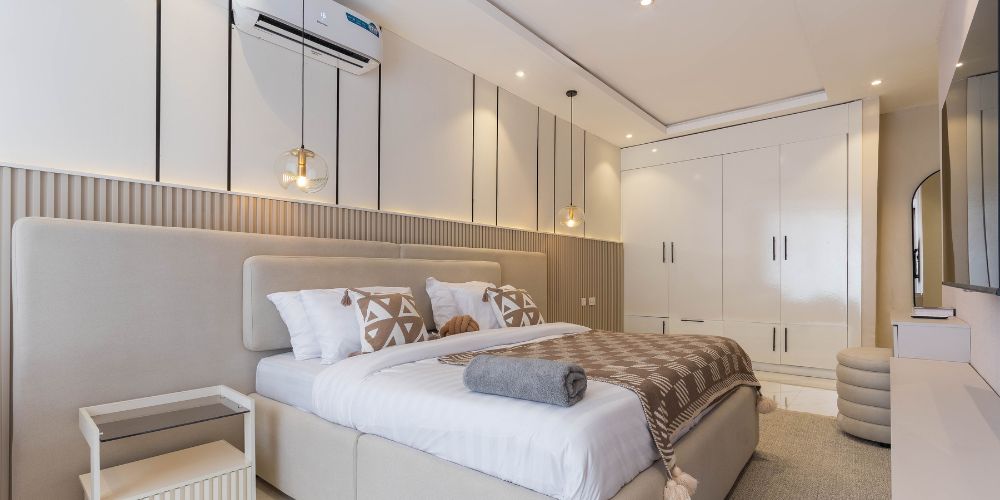
Most people have already decided the room is the problem before they have tried much else. The square footage gets blamed. The builder gets blamed. The house itself gets blamed. The furniture stays exactly where it was placed on moving-in day because nothing better has presented itself.
Worth questioning that assumption before spending money on anything.
Small bedrooms that feel impossible to live in are usually arranged badly. Not always. Sometimes the room genuinely is too tight for what needs to go in it. But that is rarer than people assume. More often the layout is working against itself and a few different decisions would change the entire feel of the space. Horizon Bespoke Joinery has worked with small bedrooms long enough to know which mistakes show up repeatedly. Most of them are surprisingly easy to avoid once someone points them out.
Measure Before Anything Else
Not a rough sense of the dimensions. Actual numbers.
Every wall length. Every window. Every door and how far it swings when it opens. Written down somewhere before a single piece of furniture gets touched.
This feels unnecessary until someone spends an afternoon shuffling a wardrobe across the room only to discover the door now opens directly into the bed. Twenty minutes of measurements prevent a genuinely frustrating afternoon.
The Bed Is the Starting Point
Not a starting point among several. The starting point.
Everything else in the room arranges itself around where the bed sits. Getting the bed wrong means every subsequent decision is harder than it should be. Getting it right means the rest often sorts itself out fairly naturally.
The Longest Clear Wall
This is where it belongs. The longest wall without a door cutting through it or a window positioned in the middle of it. A proper uninterrupted run of wall.
Centering the bed on that wall in a square room does something to the space that is hard to explain until it is seen. The room stops feeling like furniture was just placed wherever it fit. It reads as considered. That shift in how a room feels matters more than people expect.
When the Room Is Narrow
Corner placement. The bed goes into a corner and the floor space along the other walls opens up considerably. One-sided access is the trade-off. For a single person that is rarely an issue. For two people sharing it needs a bit more thought.
Under a Window
Avoid it. Light gets blocked. Airflow gets blocked. Headboards against windows are uncomfortable in ways that only become obvious after sleeping there for a week. Unless the room leaves absolutely no other option, find a different wall.
The Walls Are Not Just for Hanging Pictures
Small bedrooms tend to be overcrowded at floor level and completely empty from the waist up. All the storage pressure lands on the floor because that is where furniture naturally goes.
It does not have to.
A wall-mounted shelf at arm’s reach above the bed replaces a bedside table without using a centimetre of floor space. Lamp, phone, glass of water. Everything that normally sits on a bedside table. Gone from the floor entirely.
Tall narrow wardrobes. Not wide low ones. Tall ones that reach toward the ceiling and push storage upward into space that was doing nothing. The floor stays clear.
There is something about vertical height that the eye reads as spaciousness. It is a bit counterintuitive but it consistently works.
Before choosing any storage piece, ask whether it could go up rather than out. Usually it can.
Furniture That Pulls Double Duty
Storage beds get treated as a budget option or a last resort. They are neither.
A bed with drawers underneath replaces a chest of drawers. The storage stays. The chest of drawers disappears. Floor space recovered for nothing given up. In a small bedroom that is not a small thing.
An ottoman at the foot of the bed stores bedding. A lift-lid bench does the same. Neither takes more room than a decorative alternative would anyway.
The question worth asking about every single piece of furniture in a small bedroom: what is this actually doing here? One job done properly is acceptable. Two jobs with no extra bulk is better. Something that just occupies floor space without contributing much is worth removing.
Empty Floor Is Not Wasted Floor
This is the one that feels wrong until it is tried.
Empty space looks like inefficiency. Like an opportunity missed. But cluttered floor is what actually makes rooms feel small. Not the square footage. A bedroom with clear pathways and open floor feels easy to be in even when the dimensions are tight. A bedroom where every bit of floor is occupied by something feels cramped regardless of the actual size.
Sixty centimetres of clear space along the accessible side of the bed. Larger pieces sitting flush against walls. The middle of the room left as open as possible. The room will feel bigger than it measures. Not a trick. Just how the brain responds to open space.
What Mirrors and Light Do
Mirrors
A mirror on the wall opposite a window bounces light back across the room and changes the perceived depth noticeably. Fitted wardrobe doors with mirrored fronts do two things at once without adding anything to the footprint. Worth considering seriously rather than dismissing as an obvious suggestion.
Light and Colour
Pale walls reflect light. Dark walls eat it. In a small bedroom that is not an aesthetic question, it is a practical one. The difference between a room that feels open and one that feels closed can genuinely come down to wall colour.
Heavy curtains blocking the window quietly undermine everything else. Natural light does more for a small bedroom than most furniture decisions do. Simple light window treatments. Let the light in.
Two Things That Go Wrong Most Often
Too much furniture full stop. Three pieces chosen well work harder in a small bedroom than six average pieces fighting each other for position. Removing something is sometimes the most effective layout decision available and it costs nothing.
Conclusion
There is a point where freestanding furniture simply cannot do what the room needs.
The alcove beside the chimney breast that no standard wardrobe fits properly. The corner that accumulates clutter because nothing reaches it well. The gap above the furniture that is too shallow for storage boxes but too obvious to pretend is not there.
These are not layout problems. They are problems that layout cannot fix.
Bespoke bedroom furniture built for the specific room uses all of that space. The odd corners, the irregular walls, the spaces that off-the-shelf furniture always leaves wasted. Storage designed around the actual room rather than approximated to fit it.
In a small bedroom the difference between something made for the space and something bought to roughly fill it is usually the difference between a room that works properly and one that almost does.