


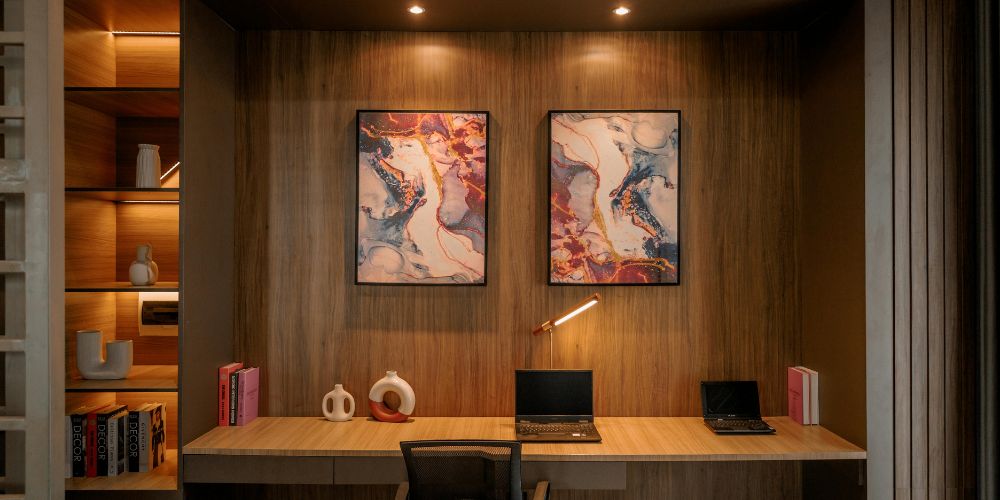
To arrange your home office furniture effectively , you should focus on prioritizing natural light, investing in ergonomic seating, managing cable clutter, and utilizing vertical storage to maximize smaller floor plans.
For more information about home office furniture design then be sure to check out Horizon Bespoke Joinery for custom home office designs.
Steps To Arrange Home Office Furniture
1. Position for Natural Light
In Ireland, where daylight can be limited during winter months, place your desk near a window. Position it at a 90-degree angle to the glass. This “side-loading” setup prevents glare on your monitor while providing enough ambient light to reduce eye strain. If you are right-handed, light should ideally come from the left to avoid shadows on your paperwork.
2. Set Up Your Ergonomic Zone
Your health depends on the “90-90-90” rule. Adjust your chair so your knees are at a 90-degree angle with feet flat on the floor. Your elbows should also rest at 90 degrees when typing. Ensure the top third of your monitor is at eye level, roughly 50cm to 70cm away from your face. Using a dedicated office chair with lumbar support is superior to using a dining chair for long-term spinal health.
3. Map Out the “Reach Zone”
Keep your most-used items, laptop, mouse, and phone within a 40cm radius of your seated position. Items you use occasionally, like printers or reference books, should be placed in the “secondary zone,” requiring you to stand or stretch. This prevents unnecessary repetitive reaching and keeps your primary workspace clear of “desk creep.”
4. Utilize Vertical Storage
Irish homes often have compact spare rooms. Instead of wide bookshelves that eat up floor space, install floating shelves or tall, narrow cabinets. Use the wall space up to 2 meters high for archives or decorative items. This keeps the floor clear, making the room feel larger and easier to vacuum.
5. Control Your Cables
Safety and aesthetics require active cable management. Use adhesive clips or a “cable spine” to bundle wires along the legs of your desk. Keeping power strips off the floor prevents a “nest” of dust and reduces trip hazards. For a clean look, try to have only one main power lead visible running to the wall socket.
How To Arrange Furniture In A Small Office Room?
To arrange furniture in a small home office room, you should prioritize the “L-shaped” layout, utilize vertical wall space, choose multi-functional furniture, and clear the floor profile to create an illusion of depth.
Get in touch with Horizon Bespoke Joinery for custom home office designs and expert furniture tips.
1. Adopt the Corner or L-Shaped Layout
In a small room, placing your desk in a corner (the L-shape) is the most efficient use of square footage. This “anchors” the furniture to one area, leaving the center of the room open. An open center makes a cramped space feel significantly larger and allows you to move your chair freely without hitting walls.
2. Maximize Vertical Storage
When floor space is limited, look up. Install floating shelves or tall, narrow bookcases that reach toward the ceiling. Keep your desk surface clear by storing reference books, printers, and supplies on these higher levels. Aim to keep only your “active” work—laptop, mouse, and notepad—on the desk itself to prevent mental clutter.
3. Choose “Leggy” or Minimalist Furniture
To make a small room feel airy, choose a desk and guest chairs with thin metal legs rather than solid, boxy bases. Being able to see the floor extending underneath your furniture tricks the brain into perceiving more space. Avoid heavy executive desks; a simple writing desk or a wall-mounted “floating” desk works best for tight dimensions.
4. Optimize Natural Light and Mirrors
Position your desk facing or adjacent to a window. If the room feels dark, place a mirror on the wall opposite the window. This reflects light and “doubles” the visual depth of the room. Avoid placing large cabinets directly next to the door, as this creates a “tunnel” effect that makes the entrance feel restrictive.
5. Use Mobile Storage Units
Instead of fixed drawers, use a slim rolling file cabinet or a utility cart. You can tuck these under your desk while working and roll them out of the way or into a closet when you need extra floor space for tasks like filming or stretching.